May 2024. Istanbul, Turkey. Opel unveils something that automotive enthusiasts didn't expect - the return of the legendary Frontera name. But this isn't your father's rugged off-roader from the 1990s. This is a modern, family-oriented electric SUV built on the same Smart Car platform as the Citroën ë-C3 Aircross. The question everyone asked: can a legendary nameplate from the era of diesel engines successfully transition to the electric age?
The original Frontera was Opel's answer to the booming SUV market of the 1990s. Built on Isuzu underpinnings, it was rugged, reliable, and surprisingly capable off-road. It sold well across Europe, becoming a symbol of affordable adventure. But that was then. The new Frontera Electric has nothing to do with its predecessor except the name and the spirit of practicality.
What we have here is a thoroughly modern electric SUV designed for families who need space, versatility, and electric range without breaking the bank. Starting at 125,900 PLN in Poland, it positions itself as one of the most affordable electric SUVs on the market. But is it just a Citroën ë-C3 Aircross with an Opel badge? Let's find out.
But Let's Start with the Basics: What Is the Opel Frontera Electric?
The Opel Frontera Electric is a compact electric SUV built on Stellantis' Smart Car platform - the same architecture underpinning the Citroën ë-C3 and ë-C3 Aircross. It's a thoroughly European product, designed at Opel's design studio and manufactured in Slovakia at the Trnava plant. This makes it eligible for certain European incentives that exclude Chinese-made vehicles.
Basic Technical Data (2025):
- Battery: 44 kWh or 54 kWh Extended Range (LFP - lithium iron phosphate)
- Motor: 83 kW / 113 HP, 120 Nm
- WLTP Range: 305 km (44 kWh) / 408 km (54 kWh Extended Range)
- 0-100 km/h Acceleration: 11 seconds (estimated)
- Top Speed: 135 km/h (estimated)
- AC Charging: 7.4 kW (standard), 11 kW (option for 1,500 PLN)
- DC Charging: 100 kW (20-80% in 26 minutes)
- Connector: CCS2 (Combo 2)
- Trunk: 460 liters (1,594 liters with rear seats folded)
Versions Available in Poland (2025):
Edition (44 kWh) - from 125,900 PLN
- 16-inch steel wheels with covers
- LED headlights
- Manual climate control
- 10-inch central touchscreen
- Reversing camera with parking sensors
- Inductive smartphone charging
- 6 airbags
- Advanced safety systems (AEB, lane assist)
Edition Extended Range (54 kWh) - from 135,900 PLN
- Same equipment as Edition
- Larger 54 kWh battery
- 408 km WLTP range (100 km more)
GS (44 kWh) - from 139,900 PLN
- 17-inch alloy wheels
- LED rear lights
- Automatic climate control
- Additional driver assistance features
- Enhanced interior trim
GS with 11 kW Charger (44 kWh) - from 141,400 PLN
- All GS features
- Three-phase 11 kW onboard charger
The Frontera Electric is positioned as a practical family SUV that doesn't try to be sporty or luxurious. It's honest, straightforward, and focused on delivering space and functionality at a reasonable price.
LFP Battery: The Same Smart Choice as Citroën
Like its Citroën sibling, the Frontera Electric uses LFP (lithium iron phosphate) battery chemistry. This is a deliberate choice prioritizing longevity, safety, and cost over maximum energy density.
Two Battery Options: Flexibility for Different Needs
44 kWh Battery (Standard):
- WLTP Range: 305 km
- Real-world summer range: 250-270 km
- Real-world winter range: 190-220 km
- For whom: Urban users, daily commutes up to 150 km
- Price advantage: Lower starting cost
54 kWh Extended Range:
- WLTP Range: 408 km
- Real-world summer range: 340-370 km
- Real-world winter range: 250-280 km
- For whom: Longer commutes, occasional road trips
- Price premium: 10,000 PLN over standard
The 54 kWh Extended Range version is particularly interesting. It's not just a bigger battery - Opel also improved efficiency, reducing consumption from 18.2-18.5 kWh/100 km to 15.8-16.5 kWh/100 km. This means you get about 100 km additional range from just 10 kWh extra capacity.
Why LFP Makes Sense Here
The advantages of LFP chemistry are particularly relevant for a family SUV:
Longevity: LFP batteries handle 3000-4000 charging cycles with minimal degradation. After 200,000 km, expect 85-90% of original capacity. For a family car that might be used for 10-15 years, this is crucial.
Safety: LFP is chemically stable and resistant to thermal runaway. When you're transporting your family, this peace of mind matters.
Cost: LFP is 20-30% cheaper to produce than NMC, allowing Opel to offer a spacious SUV under 130,000 PLN.
Temperature tolerance: While LFP performs worse in extreme cold, the Frontera's larger size and better insulation compared to the compact ë-C3 help mitigate this.
The main disadvantage remains: no active battery heating. This means winter performance will suffer, particularly for fast DC charging. On a cold morning, you might see charging speeds drop to 50-60 kW instead of 100 kW until the battery warms up.
AC and DC Charging: Understanding Your Options
AC Charging: Standard 7.4 kW vs Optional 11 kW
Here's where things get interesting for buyers. The Frontera Electric comes standard with a 7.4 kW single-phase onboard charger. But there's an optional 11 kW three-phase charger available for an additional 1,500 PLN.
Standard 7.4 kW Charger:
- 44 kWh battery: 0-100% in about 7.75 hours (465 minutes)
- 54 kWh battery: 0-100% in about 9.5 hours (estimated)
- Socket required: CEE32 single-phase (red)
- For whom: Those with single-phase home installation
Optional 11 kW Charger:
- 44 kWh battery: 0-100% in about 5 hours (300 minutes)
- 54 kWh battery: 0-100% in about 6.5 hours (estimated)
- Socket required: CEE16 three-phase
- For whom: Those with three-phase home installation
- Cost: 1,500 PLN upgrade
Should You Pay for the 11 kW Option?
The answer depends on your home electrical setup:
Choose 7.4 kW (standard) if:
- You only have single-phase electricity at home
- Installing three-phase would be prohibitively expensive
- You charge overnight and 7-8 hours is acceptable
Choose 11 kW (upgrade) if:
- You have or plan to install three-phase electricity
- You want flexibility for faster charging
- You might use public AC charging stations (many offer 11 kW or more)
- 1,500 PLN is reasonable for 35-40% faster charging
For most users with three-phase capability, the 1,500 PLN upgrade is absolutely worth it. You'll gain almost 3 hours on a full charge cycle.
DC Fast Charging: 100 kW is the Sweet Spot
The Frontera Electric supports up to 100 kW DC fast charging, which is excellent for this class:
- 20-80% charging: 26 minutes (both battery sizes)
- 10-80% charging: approximately 30-32 minutes
- Real-world charging: Expect 85-95 kW average due to charging curve
Charging Curve Analysis:
Like most electric vehicles, the Frontera charges fastest when the battery is between 10-50% state of charge:
- 10-30%: 95-100 kW
- 30-50%: 90-95 kW
- 50-70%: 75-85 kW
- 70-80%: 60-70 kW
- 80-90%: 30-40 kW
- 90-100%: 10-20 kW
Practical implication: Always plan to charge to 80% on DC stations. Charging from 80% to 100% takes almost as long as 20% to 80%, which is inefficient.
Which Ampere Point Charger for Opel Frontera Electric?
This is crucial: the right home charging solution can make or break your electric vehicle experience. Let's break it down by scenario.

Scenario 1: Standard 7.4 kW Onboard Charger + CEE32 Socket
Your car: Standard 7.4 kW single-phase charger
Your home: CEE32 single-phase socket (red)
Our Recommendation:
Q74 (7.4 kW, portable) - See offer
Why Q74 is perfect:
- Power: 7.4 kW matches your car perfectly
- Full charging 44 kWh: about 7.75 hours
- Full charging 54 kWh: about 9.5 hours
- WiFi app: Schedule charging for cheap night rates
- Statistics: Track your energy consumption
- Portable: Take it to the cottage, visit friends with EVs
- Rugged: IP66/IK10 rating means it can withstand harsh conditions
Alternative: P72 (7.4 kW, portable) - See offer
- More affordable without WiFi
- 2.4" LCD display shows charging status
- Timer function for scheduled charging
- Same reliability as Q74
Why NOT Q11/P11?
Because your car can only accept 7.4 kW. A Q11 charger can deliver 11 kW, but your car will only use 7.4 kW. You'd be paying extra for power you can't use.
Scenario 2: Optional 11 kW Onboard Charger + Three-Phase Installation
Your car: Optional 11 kW three-phase charger (paid 1,500 PLN upgrade)
Your home: CEE16 three-phase socket
Our Recommendation:
Q11 (11 kW, portable with app) - See offer
Why Q11 is the best choice:
- Power: 11 kW - utilize your car's full charging capability
- Full charging 44 kWh: about 5 hours
- Full charging 54 kWh: about 6.5 hours
- WiFi app: Complete control over charging
- Adjust current by 1A increments even during charging
- Energy statistics: Track costs per session
- Limit by kWh: Charge exactly what you need
- Portable: Great for trips to family with EVs
Q11 with Adapters - Universal option
- Includes CEE16A to Schuko adapter
- Can charge from regular 230V socket at 3.7 kW
- Maximum flexibility: works with any power source
- Ideal if you're unsure about your installation
Alternative: P11 (11 kW, portable) - See offer
- More affordable without WiFi
- 2.4" LCD display
- Same charging speed as Q11
- Simpler operation
Q11 vs P11 - Which to Choose?
Both are portable and deliver the same 11 kW charging speed. The difference:
- Q11: WiFi app, smart features, adapter option
- P11: Lower price, straightforward operation, reliable
If you value smart features and remote monitoring, choose Q11. If you prefer simplicity and want to save money, P11 is excellent.
Scenario 3: Only 230V Domestic Socket
Your home: Only standard 230V socket (no CEE)
Our Recommendation:
Q37 (3.7 kW, portable) - See offer
For whom this works:
- Very low daily mileage (under 60 km)
- Can charge for 12+ hours overnight
- Emergency backup charging solution
Charging times at 3.7 kW:
- 44 kWh battery: about 15-16 hours (0-100%)
- 54 kWh battery: about 19-20 hours (0-100%)
Reality check: This is slow. If you drive the Frontera regularly, you really should consider installing at least a CEE32 socket for 7.4 kW charging.
Alternative: P35 (3.7 kW) - See offer
- More affordable
- LCD display
- Timer function
Alternative: B35 (3.7 kW, basic) - See offer
- Most budget-friendly
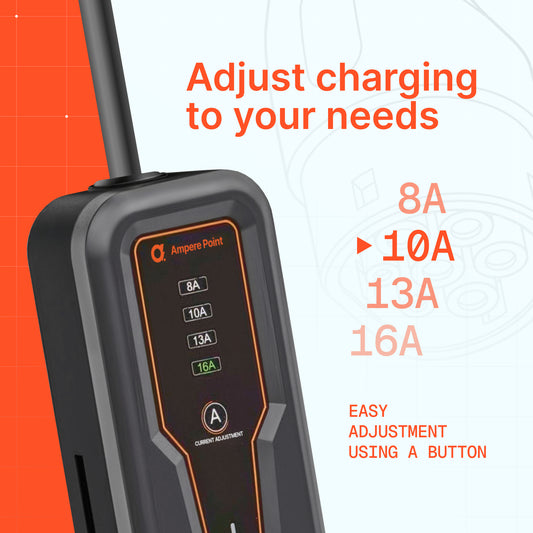
- Button-controlled current adjustment
- No LCD display
Charging Time Comparison: Frontera Electric
| Battery | Power | Charger | 0-100% | 20-80% | Daily Usage |
|---|---|---|---|---|---|
| 44 kWh | 3.7 kW | Q37/P35/B35 | ~16h | ~10h | Under 60 km/day |
| 44 kWh | 7.4 kW | Q74/P72 | ~8h | ~5h | Up to 150 km/day |
| 44 kWh | 11 kW | Q11/P11 | ~5h | ~3h | Up to 200 km/day |
| 54 kWh | 11 kW | Q11/P11 | ~6.5h | ~4h | Up to 250 km/day |
| Any | 100 kW DC | Station | ~40min | ~26min | Road trips |
Before You Buy a Charger - Check Your Socket!
This is critical! Your charging speed depends entirely on your home electrical installation.
Option 1: Standard 230V Socket (Schuko)
What it looks like: Regular wall socket - like for your TV or laptop
Charging capability:
- Power: 3.7 kW (16A, single-phase)
- Frontera 44 kWh: about 16 hours full charge
- Frontera 54 kWh: about 20 hours full charge
Warning: About 20% of household sockets have installation issues (no proper grounding, reversed polarity, undersized wiring). Quality chargers like ours will detect these problems and refuse to charge - this protects your car and home from potential electrical hazards.
Suitable for:
- Emergency backup charging
- Very light usage (under 50 km daily)
- Temporary solution while installing proper outlet
Compatible chargers: