

The electric era of the EX30
The Volvo EX30 is the unofficial start of a new era for Volvo: a Scandinavian brand, but a Chinese platform (Geely SEA), Chinese cells (CATL) and production in Zhangjiakou. That stirs up emotions, but the numbers do the talking: the EX30 is the fastest Volvo ever in Twin Motor Performance form (3.6 s to 100 km/h).
The launch in June 2023 surprised the market with its price: from PLN 180,000 for the Single Motor version. It was Volvo's first attempt to win over the middle-class customer, and not just the business customers of the S60 or XC60. The choice of the SEA platform (shared with the Smart #1 and the upcoming Zeekr X) was a surprise too, because Volvo gave up its own CMA platform in favour of Geely's.
Volvo's philosophy was surprisingly simple: the cheapest car in the range should be the fastest electric one. Single Motor 272 hp, Single Motor ER the same power but a bigger battery, Twin Motor Performance 428 hp. All with AC 11 kW (standard) and a 22 kW option for the bigger-battery versions.
The showroom catch
The salesperson will present a beautiful car, but the subject of charging power is often passed over in silence. The Volvo EX30 charges at 11 kW AC (with a 22 kW option for selected versions). We'll explain what that means for your wallet and how to avoid overpaying for a wallbox you don't need.
So what exactly is the Volvo EX30?
The Volvo EX30 is a premium compact BEV crossover. Built on the SEA platform (Sustainable Experience Architecture, Geely), it offers a purely electric drivetrain without the compromises of a combustion engine. The car was launched in 2023.
Unlike plug-in hybrids (PHEV) and classic hybrids (HEV), the Volvo EX30 is a fully electric car (BEV). No petrol engine, no fuel tank, no exhaust. All of its range comes from the battery, which you charge from a socket. Its most important trait follows from that category: a single overnight charge is enough for the daily commute.
PHEV (plug-in hybrid)
Small battery (10-25 kWh), petrol engine + electric motor. EV range of 30-100 km. Charges from a socket.
BEV (that's the Volvo EX30)
Large battery (64 kWh net), electric motor only. WLTP range of 343-480 km. No emissions.
EREV (range extender)
Medium-sized battery, a small petrol engine acting as a generator (it doesn't drive the wheels directly). E.g. BMW i3 REx.
The battery that is the heart of the Volvo EX30
The battery pack comes from China's CATL, the world's largest cell manufacturer. The Single Motor version (51 kWh) uses LFP (lithium-iron-phosphate, cheaper and more durable). The ER and Twin Motor versions (69 kWh) use NMC (nickel-manganese-cobalt, higher energy density).
Volvo uses a capacity buffer of around 5 kWh (the gross-net difference), which translates into an 8-year warranty down to 70 per cent of capacity. Real-world measurements from owners in 2023-2024 show 3-4 per cent degradation a year for the NMC versions and only 1-2 per cent for the LFP versions (LFP ages more slowly).
The EX30 has two types of battery chemistry depending on the variant, which is unique in the segment. LFP copes better with charge cycles to 100 per cent (you don't have to pay attention to the state of charge), while NMC offers more range. The 2025 Cross Country version got 22 kW AC as standard.
64 kWh net. What does that mean in practice?
With real-world energy consumption in everyday driving, 64 kWh net gives a range of 343-480 km under WLTP. That's enough for a typical week of use on a single overnight charge. DC at up to 153 kW takes care of the road-trip scenarios (10-80 per cent in 18-30 minutes).
Volvo EX30 drivetrain capabilities
The Twin Motor Performance uses two PMSM motors. 115 kW at the front, 200 kW at the rear, 428 hp and 543 Nm in total. That's a power level typical of cars like the BMW M3 (petrol), but in a quiet EV weighing 1.7 tonnes.
Volvo EX30 telemetry
System power
428 hp
Torque
543 Nm
0-100 km/h
3.6 s
Top speed
180 km/h
The EX30 offers Hibernate (energy saving), Normal and Performance (Twin Motor only) modes. No physical buttons, everything goes through the central Android Automotive screen (with YouTube and Google Maps). Real-world consumption of 17-22 kWh/100 km.
Charging. Why 11 kW AC?
The Volvo EX30 has a built-in onboard charger, or OBC (On-Board Charger), with a limit of 11 kW (three-phase, 16 A). That means that whatever the external source (wallbox, portable charger, public AC station), the car will physically cap the power at that value. Standard Type 2 (Mennekes) connector.
The standard 11 kW AC suits most home scenarios. The 22 kW option (available on the Single Motor ER and Twin Motor Performance, standard on the Cross Country) makes sense if you have a dedicated three-phase 32 A installation. In practice, 90 per cent of customers choose 11 kW and it's enough.
The Volvo EX30 accepts a maximum of 11 kW of AC power. Anything above that will be capped by the car's OBC.
Goal: full Volvo EX30 battery (100%)
230 V household socket with the car's factory charger
Standard portable charger. Only 2.3 kW (10 A)
Three-phase CEE 16A socket + Q11/P11 charger
The full 11 kW - the maximum for the Volvo EX30
CEE 32A socket + Q22 (22 kW)
Only versions with the 22 kW AC option - the full 22 kW
The most common sales myth: dealers suggest that the fastest home charging is a wallbox. That's a half-truth. A wallbox is simply a charger in a wall-mounted housing. From the car's point of view there's no difference between an 11 kW wallbox and an 11 kW portable charger plugged into a CEE socket. The charging parameters are identical. For the Volvo EX30 you'll get the fastest home charging from a portable charger or a wallbox rated at 11 kW. The portable one has an edge: you can take it to the summer house, to a hotel, to your in-laws'.
Now you know which charger you need
11 kW, Type 2, portable. No cutting into walls and no paying an electrician. Q11 with the WiFi app for PLN 1,349 or Q22 for PLN 1,549, the same power for the Volvo EX30.
Volvo EX30 vs the competition
The Volvo EX30 doesn't exist in a vacuum. The premium compact BEV crossover segment has three natural rivals worth comparing it with on charging, range and price. Each of them has a different philosophy and different strengths.
BMW iX1
11-22 kW AC, 64.7 kWh net, 440 km range. More premium, less power.
Volvo EX30
428 hp, 64 kWh net, 343-480 km range. AC 11 kW (opt. 22 kW) + DC up to 153 kW. Price PLN 180-230k.
Mercedes EQA
11 kW AC, 70.5 kWh net, 426-560 km range. Less dynamic, more family-oriented.
The third important rival in the segment: the premium segment RWD. 11 kW AC, 60 kWh LFP, 455 km range. Cheaper, but less design-led.
When does the Volvo EX30 win? A specific combination of specs: battery, power, charging and price. For most customers in Poland it's still one of the best choices in the segment. When does it lose? The WLTP range of 343-480 km is, in some versions, shorter than the competition's. But for 90 per cent of users it's enough anyway.
Two chargers ideal for the Volvo EX30
Both 11 kW. Both charge the Volvo EX30 in 6 hours. Choose the version with Smart WiFi or the simpler, cheaper one.
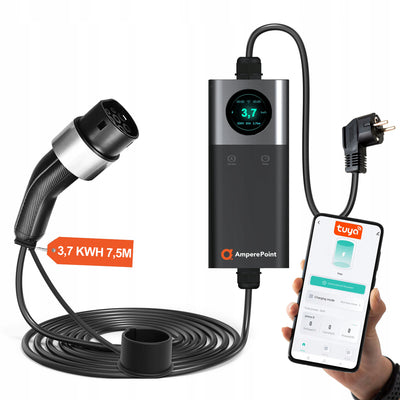
Q11 Smart WiFi (11 kW)
App, consumption monitoring, night tariff integration. 7.5 m Type 2 cable. Full charge at 11 kW in 7-8 hours.
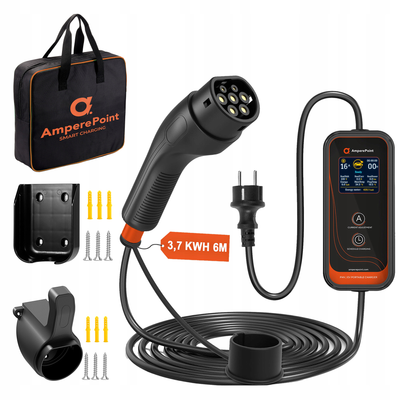
Q22 Smart WiFi (22 kW)
For versions with the 22 kW AC option. Full charge in 4 hours. Requires a three-phase CEE 32A installation.
What do the testers say about the Volvo EX30?
The Volvo EX30 has been tested by leading Polish and European motoring media and by independent EV market experts. The testers' consensus is clear: a solid car with specific strengths and weaknesses. Below is a summary of the main findings from industry tests by the motoring press and from EV market analyses.
According to industry tests by the motoring press, the EX30 covers 350-400 km in the real world on a motorway run with the Twin Motor, which is as quiet as a Scandinavian forest. That's a realistic assessment worth taking into account before you buy.
Independent road tests highlight the handling: the Twin Motor Performance version is absurdly fast, 3.6 s to 100 km/h in a car weighing less than 1.8 tonnes. That's an important point for people who value driving dynamics.
Industry analyses of the EV market indicate that Volvo makes no secret of it: the standard 11 kW is enough. 22 kW is an option for people with a three-phase installation. That matches exactly what we see at Ampere Point.
That's exactly how we see it at Ampere Point. A customer buying a Volvo EX30 gets a car designed for overnight 11 kW charging. Our Q11 and Q22 portable chargers are a perfect match: the full 11 kW, a Type 2 cable, 6 hours to a full battery. No wallbox, no electrician, no cutting into the wall.
Bottom line. Who the Volvo EX30 is for and which charger
The Volvo EX30 is the choice for someone who wants a premium compact BEV crossover with a fully electric drivetrain. It's a perfect fit when: your daily commute is within the battery's range, you have access to a socket in the garage or in the car park, and you accept the need for DC on the road. Charger recommendation: if you value in-app consumption monitoring and night tariff integration, choose Q11 (PLN 1,349). If a simple, reliable charger is enough for you, go for Q22 (PLN 1,549). Both deliver the full 11 kW, both charge the Volvo EX30 in 6 hours, and you can take both on holiday. A 22 kW wallbox bought for a Volvo EX30 makes sense ONLY if you have the version with the 22 kW AC option.
"If you don't charge every day, you're driving on reserve and losing battery range for no reason. Sort out the socket and make plugging in a routine for savings of around 80% compared with fossil fuels."
Editorial sources
(1) Volvo Polska, official product sheet for the Volvo EX30 (2023-2025)
(2) ADAC e.V., Volvo EX30 test, 2024-2025
(3) Road tests of the Volvo EX30 - motoring trade press, 2023-2025
(4) Independent handling and dynamics tests of the Volvo EX30
(5) Industry analyses of the EV market - 11 kW AC charging in the segment
(6) Ampere Point, EV Charging Speed Explained, company blog
(7) Ampere Point, EV and Hybrid Charging from A to Z, company blog
(8) EV Database, technical data for the Volvo EX30, ev-database.org
(9) CATL, official documentation for NMC cells (Single Motor ER, Twin Motor) or LFP cells (Single Motor)
(10) Bundesnetzagentur, statistics on AC charger rollout, 2020-2025
Recommendations for the Volvo EX30
Matched to your car's 11 kW limit.