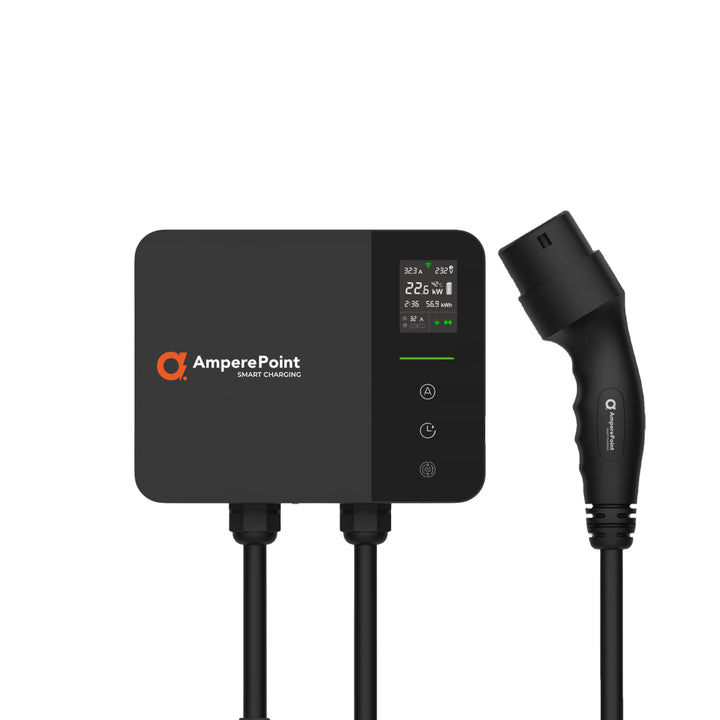
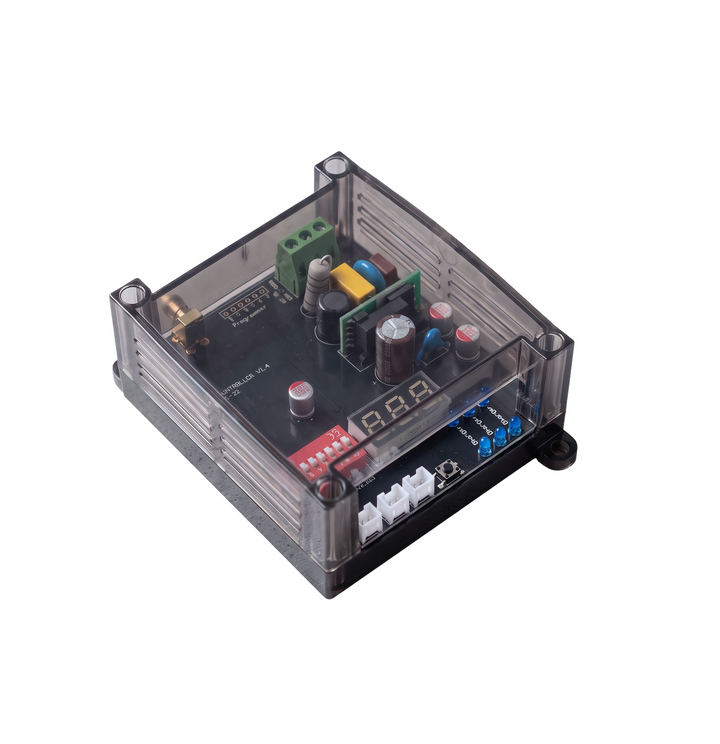
A wallbox is a wall-mounted charger for an electric car, permanently installed and connected to its own circuit in the consumer unit. What sets it apart from charging at a socket is the durability of the connection and the power: an ordinary 230 V socket will safely deliver around 2.3 kW under a load lasting several hours, while a wallbox works at 11 kW or 22 kW. For most drivers that means a full battery every morning, with no planning and no trips to charging stations.
The PRIME series comprises two models: 11 kW and 22 kW. Both have an integrated 7.5-metre Type 2 cable ending in a plug, an IP65 enclosure suitable for outdoor mounting, app control over WiFi, OTA firmware updates, RFID access control and an emergency stop button.
Wallbox or portable charger: which to choose for home
A portable charger works as a supplement, not a replacement. You take it on the road, charge at a relative's house or at work, and at home you plug it into an industrial socket. A wallbox is the permanent solution: there is no need to take it out of the boot every time, it has a fixed plug holder, access control and full protection built into the device.
If you park in a garage or on your own driveway and charge every day, a wallbox is more convenient and less prone to failure. If you often change where you charge, it is worth having both.
Wallbox 11 kW or 22 kW: which power for home
The starting point is the on-board charger in your car, that is the maximum AC power the car accepts. Most electric cars have an 11 kW limit, and a more powerful wallbox will not speed up their charging by a single minute.
11 kW wallbox: the standard choice for a detached house. It is enough for the Tesla Model 3, Skoda Enyaq, Volkswagen ID.4, Kia EV6 and most plug-in hybrids.
22 kW wallbox: choose it when your car supports 22 kW AC (some Renault, Smart and Zoe models, for instance), when you charge two cars in turn, or when you are building an installation for a business with the future in mind.
How long charging with a wallbox takes
Charging time is simple arithmetic: battery capacity divided by charging power. A car with a 50 kWh battery on an 11 kW wallbox will charge from empty to full in about 4.5 hours, and a 77 kWh battery in about 7 hours. These are rough figures, because the real time depends on the on-board charger, the state of charge and the temperature.
In practice something else matters: an average driver covers a few dozen kilometres a day, which means 5 to 15 kWh. A wallbox replaces that much energy in under an hour, and an off-peak tariff makes it the cheapest way to charge an electric car.
PRIME series features that matter in daily use
App and WiFi
From your phone you can set a charging schedule to match an off-peak tariff, check energy use in kWh and limit the current when other appliances are running in the house. OTA updates download over WiFi, with no service visit.
RFID access control
Charging starts when a card is presented. This makes sense in an underground garage, on a shared driveway or in a company car park, where the charger is in a publicly accessible place.
The 7.5-metre cable and Type 2 plug
A longer cable lets you park nose-in or reverse in and still reach the charging inlet, whichever side of the car it is on. Type 2 is the European standard and fits every electric car and plug-in hybrid sold in Europe.
Safety
The IP65 enclosure copes with rain and dust, so the wallbox can be mounted on a facade. The emergency stop button cuts charging off in one movement.
Installing a wallbox: what the installation requires
A wallbox is installed by a qualified electrician. It needs a separate circuit with overcurrent and residual current protection matched to the power of the device, and a check on the capacity of the supply so that charging does not clash with the rest of the house.
In a detached house no permit is usually required. In a block of flats or a multi-space garage you need the consent of the residents' association or housing cooperative, and often a fire safety opinion as well. In that situation RFID access control makes it easier to settle charging costs between residents.
What a home wallbox costs
Current prices for the PRIME 11 kW and 22 kW are shown on the product pages in this collection. On top of that comes the cost of installation, which depends on the distance from the consumer unit and the condition of the building's wiring. Courier delivery is free, you have 30 days to return the device, and it is covered by the manufacturer's warranty. Ampere Point is a Polish brand with its own service centre and laboratory in the country, so a warranty claim does not mean shipping the equipment abroad.
Not sure which model suits your car
Use the compatibility finder on this collection page: choose the make, model and year, and the system will show the matching chargers. You can also write or call and we will advise based on your car's specification and your home installation.