

The electric era of the Q4 e-tron
The Q4 e-tron is the most popular electric Audi in Poland and one of the most common fleet choices of 2024. Although it shares the MEB platform with the VW ID.4 (in engineering terms they are effectively the same car), Audi has managed to add a premium layer that justifies the PLN 30,000 price difference.
The launch in June 2021 was the moment Audi moved from electric supercars (e-tron GT) into the mainstream. The Q4 e-tron is the first "sensible" electric Audi: not huge, not crazy, just a solid family SUV. Sales passed 200,000 in Europe by the end of 2024.
Audi, together with VW Group, chose the MEB (Modular Electric Drive) platform as the base for all EVs in the compact and C segments. The Q4 e-tron is an ID.4 with a more luxurious interior, a better-tuned chassis and a progressive exterior design. Same guts, different suit.
The showroom catch
The salesperson will show you a beautiful car, but the subject of charging power often gets passed over in silence. The Audi Q4 e-tron 40 charges at 11 kW AC. We'll explain what that means for your wallet and how to avoid overpaying for a wallbox you don't need.
So what exactly is the Audi Q4 e-tron 40?
The Audi Q4 e-tron 40 is a premium compact BEV SUV. Built on the MEB platform (shared with the VW ID.4), it offers a purely electric drivetrain without the compromises of a combustion engine. The car was launched in 2021 and received its LCI facelift in 2024.
Unlike plug-in hybrids (PHEV) and classic hybrids (HEV), the Audi Q4 e-tron 40 is a fully electric car (BEV). There's no petrol engine, no fuel tank, no exhaust. All of its range comes from the battery, which you charge from a socket. Its most important trait comes from that category: a single overnight charging session is enough for the daily commute.
PHEV (plug-in hybrid)
Small battery (10-25 kWh), petrol engine + electric motor. EV range of 30-100 km. Charges from a socket.
BEV (that's the Audi Q4 e-tron 40)
Large battery (77 kWh net), electric motor only. WLTP range of 528 km. No emissions.
EREV (range extender)
Medium-sized battery, a small petrol engine acting as a generator (it doesn't drive the wheels directly). E.g. BMW i3 REx.
The battery that is the heart of the Audi Q4 e-tron 40
The pack, 82 kWh gross and 77 kWh net, comes from Korea's LG Energy Solution. The NCM 622 cells (60-20-20) are more conservative in terms of density than 811, but offer better cycle life. It's a deliberate choice: Audi positions the Q4 as a car for 10+ years.
A 5 kWh buffer protects the cells. Audi guarantees the pack for 8 years or 160,000 kilometres, down to 70 per cent of capacity. Real-world measurements from 2021-2022 Q4 e-tron cars show 2-3 per cent degradation per year. After the 2024 LCI, thermal management was improved.
The 2024 Q4 e-tron LCI got an 82 kWh battery as standard (previously it was 77 kWh net from 82 gross), new BMS software and a heat pump as standard. DC was raised from 135 kW to 175 kW. Range went up by 40 km.
77 kWh net. What does that mean in practice?
With real-world energy consumption in everyday use, 77 kWh net gives a range of 528 km according to WLTP. That's enough for a typical week of use on a single overnight charge. DC at up to 175 kW takes care of road-trip scenarios (10-80 per cent in 18-30 minutes).
Audi Q4 e-tron 40 drivetrain capabilities
The Q4 e-tron 40 (RWD) has a single PMSM synchronous motor at the rear producing 210 kW (286 hp) and 545 Nm. Single-speed reduction gearbox. The 50 quattro version has an additional motor at the front (80 kW), giving a total output of 299 hp.
Audi Q4 e-tron 40 telemetry
System power
286 hp
Torque
545 Nm
0-100 km/h
6.7 s
Top speed
160 km/h
The Q4 e-tron offers Efficiency, Comfort, Auto, Dynamic and Individual modes. There's no Sport mode like in the real S/RS saloons - that's a deliberate positioning choice (a family car, not a sports car). Real-world consumption of 17-20 kWh/100 km in the combined cycle.
Charging. Why 11 kW AC?
The Audi Q4 e-tron 40 has a built-in onboard charger, or OBC (On-Board Charger), with a limit of 11 kW (three-phase, 16 A). That means that whatever the external source (wallbox, portable charger, public AC station), the car will physically cap the power at that value. Standard Type 2 (Mennekes) connector.
Audi deliberately gave the whole Q4 range 11 kW AC (even though the e-tron GT has 22 kW). The reason: the Q4 customer charges at home overnight and doesn't need fast AC. DC at 175 kW (post-LCI) takes care of the road-trip scenario.
The Audi Q4 e-tron 40 accepts a maximum of 11 kW of AC power. Anything above that will be capped by the car's OBC.
Goal: full Audi Q4 e-tron 40 battery (100%)
230 V household socket with the car's factory charger
Standard portable charger. Only 2.3 kW (10 A)
Three-phase CEE 16A socket + Q11/P11 charger
The full 11 kW - the maximum for the Audi Q4 e-tron 40
22 kW wallbox or three-phase CEE 32A
Expensive kit, but the Audi Q4 e-tron 40 will cap it at 11 kW anyway
The most common sales myth: dealers suggest that the fastest home charging is a wallbox. That's a half-truth. A wallbox is simply a charger in a wall-mounted housing. From the car's point of view there's no difference between an 11 kW wallbox and an 11 kW portable charger plugged into a CEE socket. The charging parameters are identical. For the Audi Q4 e-tron 40 you'll get the fastest home charging from a portable charger or a wallbox rated at 11 kW. The portable one has an edge: you can take it to the summer house, to a hotel, to your in-laws.
Now you know which charger you need
11 kW, Type 2, portable. No cutting into walls and no paying an electrician. Q11 with the WiFi app for PLN 1,349 or P11 for PLN 999, the same power for the Audi Q4 e-tron 40.
Audi Q4 e-tron 40 vs the competition
The Audi Q4 e-tron 40 doesn't exist in a vacuum. The premium compact BEV SUV segment has three natural rivals worth comparing it with on charging, range and price. Each of them has a different philosophy and different strengths.
VW ID.4 Pro
11 kW AC, 77 kWh, 286 hp, 544 km of range. Identical car in engineering terms, PLN 30,000 cheaper.
Audi Q4 e-tron 40
286 hp, 77 kWh net, 528 km range. AC 11 kW + DC up to 175 kW. Price PLN 270,000.
Skoda Enyaq 80
11 kW AC, 77 kWh, 204 hp, 533 km. The Czech sibling, cheaper still.
The third important rival in the segment: BMW iX1 xDrive30. 11-22 kW AC, 64.7 kWh net, 313 hp, 440 km. A smaller battery but faster AC.
When does the Audi Q4 e-tron 40 win? A specific combination of parameters: battery, power, charging and price. For most customers in Poland it's still one of the best choices in the segment. When does it lose? The WLTP range of 528 km is, in some versions, lower than the competition's. But for 90 per cent of users it's enough anyway.
Two chargers ideal for the Audi Q4 e-tron 40
Both 11 kW. Both charge the Audi Q4 e-tron 40 in 7 hours. Choose the version with Smart WiFi or the simpler, cheaper one.
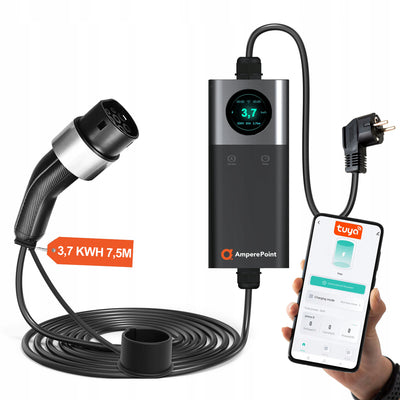
Q11 Smart WiFi (11 kW)
App, consumption monitoring, night tariff integration. 7.5 m Type 2 cable. Full charge in 7-8 hours.
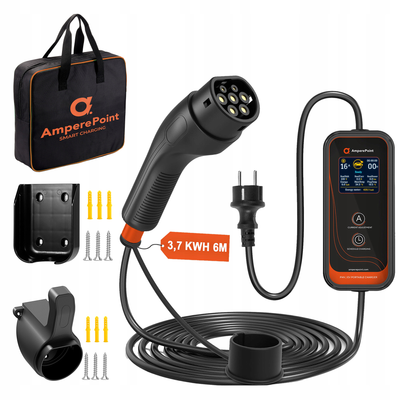
P11 with LCD (11 kW)
Solid build with no app. LCD display with charging parameters. Identical 11 kW power. Lower price.
What do the testers say about the Audi Q4 e-tron 40?
The Audi Q4 e-tron 40 has been tested by leading Polish and European motoring media and by independent EV market experts. The testers' consensus is clear: a solid car with specific strengths and weaknesses. Below is a summary of the main findings from industry tests by the motoring press and EV market analyses.
According to industry tests by the motoring press, the Q4 e-tron in its 40 version does 400-440 km of real-world range, and as much as 480 km in summer. It's a realistic assessment worth taking into account before you buy.
Independent road tests highlight the handling: Audi did something with the MEB platform that VW couldn't: it set up the steering assistance in a way that feels pleasant. That matters to people who value driving dynamics.
Industry analyses of the EV market indicate that 11 kW AC is the segment standard, and Q4 customers mostly charge at home anyway. That matches exactly what we see at Ampere Point.
That's exactly how we see it at Ampere Point. A customer buying an Audi Q4 e-tron 40 gets a car designed for overnight 11 kW charging. Our Q11 and P11 portable chargers are a perfect match: the full 11 kW, a Type 2 cable, 7 hours to a full battery. No wallbox, no electrician, no cutting into the wall.
Bottom line. Who the Audi Q4 e-tron 40 is for and which charger
The Audi Q4 e-tron 40 is a choice for someone who wants a premium compact BEV SUV with a fully electric drivetrain. It's a perfect fit when: your daily commute fits within the battery's range, you have access to a socket in the garage or car park, and you accept the need for DC on the road. Charger recommendation: if you value in-app consumption monitoring and night tariff integration, choose Q11 (PLN 1,349). If a simple, reliable charger is enough for you, go for P11 (PLN 999). Both deliver the full 11 kW, both charge the Audi Q4 e-tron 40 in 7 hours, both can come with you on holiday. A 22 kW wallbox bought for an Audi Q4 e-tron 40 is a classic example of a solution looking for a problem - don't let the showroom talk you into that kind of investment.
"If you don't charge every day, you're driving on reserve and losing battery range for no reason. Sort out the socket and make plugging in a routine for savings of around 80% compared with fossil fuels."
Editorial sources
(1) Audi Polska, official product sheet for the Audi Q4 e-tron 40 (2021-2025)
(2) ADAC e.V., Audi Q4 e-tron 40 test, 2022-2025
(3) Road tests of the Audi Q4 e-tron 40 - motoring trade press, 2023-2025
(4) Independent handling and driving dynamics tests of the Audi Q4 e-tron 40
(5) Industry analyses of the EV market - 11 kW AC charging in the segment
(6) Ampere Point, EV Charging Speed Explained, company blog
(7) Ampere Point, EV and Hybrid Charging from A to Z, company blog
(8) EV Database, technical data for the Audi Q4 e-tron 40, ev-database.org
(9) LG Energy Solution, official NCM 622 cell documentation
(10) Bundesnetzagentur, AC charger roll-out statistics, 2020-2025
Recommendations for the Audi Q4 e-tron 40
Matched to your car's 11 kW limit.