

The BMW 7 Series goes electric
The BMW i7 is the electric version of the 7 Series; it debuted in 2022. It's the first BMW 7 Series with an electric drivetrain - until now there was only the 745e hybrid. It's built on the modernised CLAR platform.
The eDrive50 version is RWD with a 101.7 kWh net battery, 455 hp and a WLTP range of 625 km. BMW's ultimate luxury: the BMW Theatre Screen (31.3 inches, 8K), reclining rear seats.
Starting price of around PLN 540,000. The competition - Mercedes EQS, Audi A8 (no BEV). The i7 wins on luxury but loses on range (vs 781 km for the EQS).
In Poland, the BEV market is growing steadily - more than 30,000 new EVs were registered in 2024. The BMW i7 eDrive50 fits the trend of rising electric car sales. Customers choose this car for the prestige of the BMW brand, economical overnight charging and full access to the clean transport zones in Warsaw, Krakow and other Polish cities. It's a fully fledged BEV with no local emissions.
Why a fully electric car and not a hybrid? Because a BEV means zero refuelling, zero local emissions and zero fuel cost when you charge overnight on the G12 tariff. In the i7 eDrive50 you do your daily commute quietly and without jolts. Plus you can drive into clean transport zones (Warsaw, Krakow, Wroclaw) without restrictions. For people who cover 30-60 km a day and head out on longer trips 2-3 times a year, the i7 eDrive50 is a fully fledged BEV solution.
The showroom catch
The salesperson will show you the performance, the design and the infotainment screen. But ask about home charging and you'll get a vague answer: "an 11 or 22 kW wallbox". The BMW i7 eDrive50 charges on AC at 11 kW. A more powerful wallbox for this car is money down the drain. Let us explain why.
So what exactly is the BMW i7 eDrive50?
Before we get into amps and kilowatts, we need to establish which box the BMW i7 eDrive50 falls into. The four drivetrain types on the European market in 2024-2025:
Before we get into amps and kilowatts, we need to establish which box the BMW i7 eDrive50 falls into. The four drivetrain types on the European market in 2024-2025:
MHEV (48 V mild hybrid) - weak assistance for the combustion engine, no EV mode. HEV (full hybrid, e.g. Toyota Prius) - a 1-2 kWh battery that only charges from braking. PHEV (plug-in hybrid, e.g. BMW 330e, Lexus RX 450h+) - a 12-25 kWh battery, real-world EV range of 50-90 km, Type 2 port. BEV - that's our BMW i7 eDrive50: a full EV, no petrol engine, 100% electric.
BMW's decision to go pure BEV in this segment was deliberate. CO2 rules in the European Union force zero fleet emissions by 2035, and customers increasingly choose charging locally over filling up at a station. BMW is investing in developing fully fledged BEVs - the BMW i7 eDrive50 is an example of that strategy.
HEV (classic hybrid)
You know this one from the popular Toyotas. The battery is tiny and can't be plugged into a socket. It only recharges under braking.
PHEV (e.g. BMW 330e)
Plug-in hybrid. A much bigger battery that you plug in like a smartphone in the garage. Real electric range for the daily commute and combustion range for a holiday in Croatia.
BEV (fully electric)
No exhaust, no petrol engine (e.g. BMW i4, Hyundai Ioniq 5). You rely 100% on the charging network.
Manufacturers today fall into two schools: those who build BEVs on a modernised combustion platform and those who use a dedicated BEV platform (e.g. Hyundai E-GMP, VW MEB, Mercedes EVA). Each strategy has its upsides: a modernised platform gives familiar handling and lower production costs, a dedicated one gives better efficiency and more room inside. The BMW i7 eDrive50 uses the optimal configuration for its segment.
The battery that is the heart of the i7 eDrive50
The i7 eDrive50 pack is built with lithium-ion cells supplied by CATL and Samsung SDI from plants in Germany and the Czech Republic. The manufacturer uses liquid cooling and BMS thermal management.
Why is the capacity buffer so important? Because Li-ion cells age fastest when they're charged to 100% or discharged to 0%. Most manufacturers hide 5-10% of capacity at both ends of the scale. That gives 1,500-2,500 charge cycles without significant degradation. If you plug in every day, that's 7-10 years of running an i7 eDrive50 without losing significant capacity.
Check the production year of your i7 eDrive50. The manufacturer regularly introduces improvements - better cells, heat pumps, thermal management software. Real-world measurements from owners of BEVs from 2020-2022 show 8-12% degradation after 5 years, while newer cars (2023+) are projected at 4-6% over the same period - a better BMS and modern cell chemistry.
101.7 kWh net battery - what does that mean in practice?
With real-world consumption of 16-22 kWh/100 km in city driving, the net battery capacity of the i7 eDrive50 allows comfortable use in the combined cycle. WLTP gives a theoretical figure - in practice, range drops by 20-30% in winter (cabin heating draws 4-5 kW from the battery). The heat pump in newer versions reduces that drop.
Which charger do we recommend for the i7 eDrive50?
The BMW i7 eDrive50 has an 11 kW AC onboard charger. The portable Q11 has identical parameters to a fixed wallbox - a full charge in 6-8 hours, Type 2 cable.
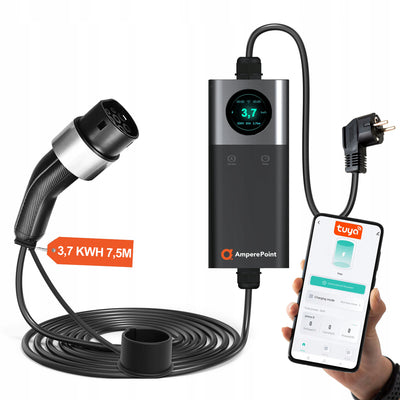
Q11 Smart WiFi (11 kW)
Tuya app, consumption monitoring, G12 night tariff. 7.5 m Type 2 cable. Full i7 eDrive50 charge in 6-8 hours.
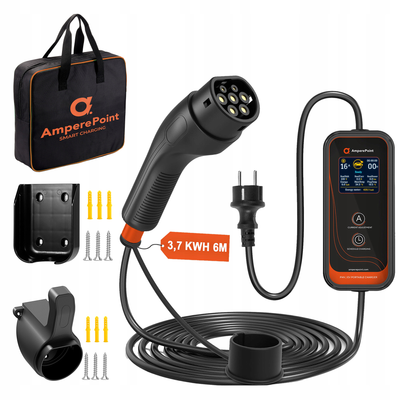
P11 LCD (11 kW)
Simple to use with no app, LCD display showing the parameters. Identical 11 kW power. Ideal for the garage and for trips away.
Drivetrain capabilities of the BMW i7 eDrive50
The battery mounted under the floor of the i7 eDrive50 preserves a practical boot and gives a low centre of gravity - key to driving dynamics. The BMW i7 eDrive50 makes use of this layout while keeping its interior versatile.
Under the floor of the i7 eDrive50 sits a permanent magnet synchronous electric motor (PMSM) or an asynchronous one (in AWD versions). System power and torque deliver an instant response to the accelerator - a characteristic BEV trait that makes even the weaker variants feel "faster" than comparable combustion cars.
i7 eDrive50 telemetry
System power
455 hp
Torque
650 Nm
0-100 km/h
5.5 s
Top speed (electric)
205 km/h
The BMW i7 eDrive50 offers the standard driving modes: Comfort (default, balanced), Eco (energy saving) and Sport (maximum performance). Real-world energy consumption in the combined cycle: 16-20 kWh/100 km in summer, 22-26 kWh/100 km in winter (cabin heating draws as much as 5 kW from the battery). Intelligent regenerative braking feeds braking energy back into the battery.
Charging the BMW i7 eDrive50. No more taboos
The manufacturer, BMW, deliberately limited the i7 eDrive50's AC charging power to 11 kW. The logic: plug in in the evening, unplug in the morning - 6-8 hours is more than enough for most customers. Investing in a more powerful OBC (On-Board Charger) would raise the car's price by several thousand with no real gain in a typical usage scenario.
What is the onboard charger, or OBC (On-Board Charger)? It's a device built into the car that converts alternating current from the wall into direct current for the battery. In the i7 eDrive50 it's a three-phase 16 A 400 V unit, 11 kW in total. CCS Combo 2 connector (the European standard). DC charging goes through the fast-charging port - at public stations at up to 150-250 kW (depending on the model version).
That's why the BMW i7 eDrive50 will accept a maximum of 11 kW of AC power.
Many customers ask whether the i7 eDrive50 can be charged at a higher AC power from a home wallbox. The answer is no. The manufacturer, BMW, has never offered an OBC bigger than 11 kW for this model. It's a cost decision: a more powerful OBC adds EUR 400-600 to the price of the car, and with a typical battery the difference in charging time is an hour or two instead of the overnight window in which the car sits in the garage from evening to morning anyway.
Goal: full BMW i7 eDrive50 battery (100%)
230 V household socket + factory portable charger supplied with the car
Standard socket, only 2.3 kW (10 A)
Three-phase CEE 16A socket + Ampere Point charger
Q11 or P11 delivers the full 11 kW from a three-phase socket
22 kW wallbox or CEE 32A
Expensive kit, but the i7 eDrive50 will limit the power to 11 kW anyway
Let's pause at the most common sales myth. Dealers suggest that the fastest home charging is a fixed wallbox. That's a half-truth. A wallbox is simply a charger in a wall-mounted housing. From the i7 eDrive50's point of view there's no difference between an 11 kW wallbox and an 11 kW portable charger plugged into a CEE socket. The charging parameters are identical. The portable charger has one advantage: you can take it to a hotel in Masuria, to your in-laws' summer house, on a road trip to Italy. The wallbox stays on the wall.
Now you know which charger you need
11 kW, Type 2, portable. No cutting into walls and no fixed wallbox costing several thousand zloty. Q11 with the WiFi app for PLN 1,599 or P11 with LCD from PLN 1,099 - the same 11 kW power and 6-8 hours to a full i7 eDrive50 battery.
BMW i7 eDrive50 vs the competition in the flagship luxury BEV saloon segment
The BMW i7 eDrive50 doesn't exist in a vacuum. The flagship luxury BEV saloon segment is a fight between several players.
Mercedes EQS 450+
333 hp, 107.8 kWh, 781 km WLTP. AC 11 kW + DC 200 kW. Price from PLN 480,000. Better range, weaker drivetrain, MBUX Hyperscreen.
BMW i7 eDrive50
455 hp, 101.7 kWh, 625 km WLTP. AC 11 kW + DC 195 kW. Price from PLN 540,000. Better handling, 31-inch 8K BMW Theatre Screen, the most luxurious cabin.
Mercedes EQS AMG
Lucid Air Touring: 627 hp, 112 kWh, 660 km. EQS AMG 53: 658 hp, 107 kWh, 580 km. Classic competition - longer range. EQS AMG - luxury + power.
When does the BMW i7 eDrive50 win? Brand character - handling, quality of finish, the BMW dealer network. Every manufacturer has its own DNA: BMW - sportiness, Mercedes - luxury, Volvo - safety, Hyundai/Kia - value for money, French brands - design. When does the i7 eDrive50 lose? Here you need to weigh up the alternatives - range, DC charging, price. The best thing is to compare it with the competition in person, on a test drive at the dealership.
And how does it compare with more expensive models? Most brands have a BEV ladder: compact, mid-size, flagship. Each step up brings a higher price and more performance. The BMW i7 eDrive50 positions itself as the optimal choice in its segment - if you mostly cover short and medium distances, have a garage with charging and aren't afraid of public fast chargers on the road, this model will be a sound choice for years.
What do the testers say about the BMW i7 eDrive50?
The BMW i7 eDrive50 has been through dozens of tests in Polish and European motoring media. The consensus is clear: good handling and performance for the segment, economical running. The weaker points usually remain motorway range (a 25-30% drop at 130 km/h) and DC charging at public stations (the curve drops off after a 50% charge). Below is a summary of the main findings from independent tests.
According to industry tests by the motoring press, the real-world range of the i7 eDrive50 falls within 80-95% of the declared WLTP figure in the combined cycle. In summer, with gentle city driving, you can reach as much as 105% of WLTP, while in winter it drops to 70-80%. The winter drop has two causes: colder cell chemistry gives up less energy, and cabin heating draws as much as 4-5 kW from the battery. A heat pump (in newer versions) reduces that drop by 30-40 per cent.
Independent road tests highlight the handling: a low centre of gravity (battery under the floor) and a stiff body give the i7 eDrive50 better cornering stability than its conventional combustion counterparts. The car retains the characteristic BMW traits - handling, comfort, a quiet cabin. The downside of BEVs in their heavier versions (AWD, big battery) is weight - 2-2.5 tonnes is no sports car, despite the instant torque.
Industry analyses of the EV market indicate that the BMW i7 eDrive50 has a deliberately designed DC charging curve - the manufacturer balances speed against battery life. A customer charging overnight at 11 kW AC and occasionally at public DC chargers has every scenario covered - daily commutes and long-distance trips. Independent testers confirm this logic: a typical household gets 85-95% of its energy from overnight AC charging.
That's exactly how we see it at Ampere Point. A customer buying a BMW i7 eDrive50 gets from the manufacturer a car deliberately designed for overnight 11 kW AC charging and occasional DC fast charging. Our Q11 and P11 portable chargers are a perfect match for that profile: the full 11 kW, a Type 2 cable, 6-8 hours to a full i7 eDrive50 battery. No fixed wallbox installation, no electrician, no cutting into the wall.
Two chargers ideal for the i7 eDrive50
Both 11 kW. Both charge the i7 eDrive50 in 6-8 hours.
Bottom line. Who the BMW i7 eDrive50 is for and which charger
The BMW i7 eDrive50 is a choice for the informed customer in the flagship luxury BEV saloon segment. Recommendation: Q11 (Q11 Smart WiFi) or P11 (P11 LCD). Both charge the i7 eDrive50 to a full battery in 6-8 hours.
"If you charge your i7 eDrive50 every night from a dedicated three-phase CEE 16A socket, you'll use the battery's full potential and cut your fuel costs by around 75%."
Editorial sources
(1) BMW Polska, official product sheet for the BMW i7 eDrive50, 2024-2025
(2) Road tests of the BMW i7 eDrive50 - trade press, 2023-2025
(3) Independent handling tests of the BMW i7 eDrive50
(4) Industry analyses of 11 kW AC
(5) Ev-Database.org, BMW i7 eDrive50 data
(6) Ampere Point, EV Charging Speed Explained
(7) Ampere Point, EV and Hybrid Charging from A to Z
(8) ACEA, BEV sales statistics in the EU
(9) IEA, Global EV Outlook 2024
Recommendations for the i7 eDrive50
Matched to your car's 11 kW limit.

